How Much Water Should a Cat Drink a Day? Amounts by Weight
Written by Malik Khurram, who is not a veterinarian. Every figure is checked against the sources listed at the end. This post has not been reviewed by a vet. See our editorial policy.
Quick answer
A cat needs about 4 oz (120 mL) of water per 5 lb of lean body weight a day, so a 10 lb cat needs roughly 1 cup. That total includes the water in food. Wet-fed cats may barely drink, while dry-fed cats must drink nearly all of it. Over 100 mL/kg a day is too much.
How much water should a cat drink? Less than most of us expect from the bowl, and more than most cats manage on dry food. The useful number is total water, from food and drinking combined. We’ll give you the vet rule of thumb, a chart by weight, and a worked example using our cat food calculator to show how much the food itself supplies.
How much water does a cat need a day?
Cornell’s Feline Health Center says a cat needs about 4 ounces of water for every 5 pounds of lean body weight each day. Use her ideal weight, not her current weight, if she’s carrying extra. Here’s what that looks like:
| Lean body weight | Total water per day | Too much (over 100 mL/kg) |
|---|---|---|
| 6 lb (2.7 kg) | About 145 mL (5 oz) | Over 270 mL |
| 8 lb (3.6 kg) | About 190 mL (6.5 oz) | Over 360 mL |
| 10 lb (4.5 kg) | About 240 mL (8 oz, 1 cup) | Over 450 mL |
| 12 lb (5.4 kg) | About 285 mL (9.5 oz) | Over 540 mL |
| 15 lb (6.8 kg) | About 355 mL (12 oz) | Over 680 mL |
Treat these as a ballpark. A 2025 review of 32 studies found healthy cats took in anywhere from 23 to 51 mL per kg a day in total, a bit under the National Research Council’s reference figure of 50 to 60. So a healthy cat drinking less than the chart isn’t automatically dehydrated. One caveat on that review: some of its authors have links to the pet food industry.
How much of that comes from food?
This is why the question is so confusing. Merck lists canned cat food at 60% to over 87% moisture and dry food at just 3% to 11%. A wet-fed cat can get most of its water from dinner. A dry-fed cat has to drink nearly all of it.
The review backs this up: cats on dry food took in less water overall and had more concentrated urine.
Worked example: a 10 lb cat on wet, dry or mixed food
Say you have a 10 lb, neutered adult cat at a healthy weight. In the cat food calculator, choose “Adult, spayed/neutered”. It suggests about 260 kcal a day. Using the default food values (90 kcal per can, 400 kcal per cup of dry):
| Diet | Calculator says | Water from food (approx.) | Left to drink to reach ~240 mL |
|---|---|---|---|
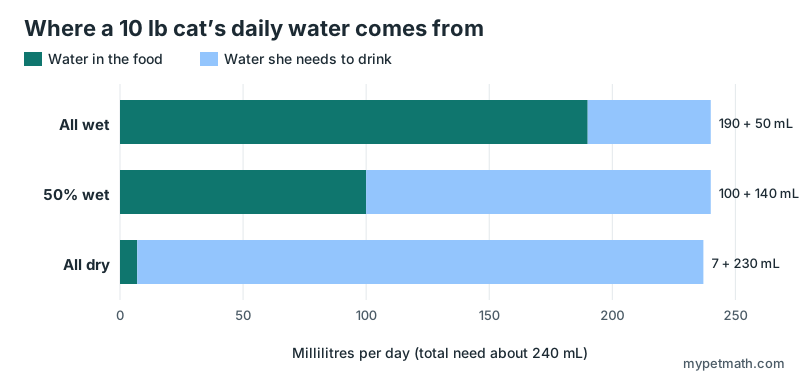
| All wet | 2⅞ cans | About 190 mL (2.9 cans × 85 g at 78% moisture) | About 50 mL |
| 50% wet | 1½ cans + ⅜ cup dry | About 100 mL | About 140 mL |
| All dry | ⅝ cup dry (about 69 g) | About 7 mL | About 230 mL |
We assumed 3 oz (85 g) cans and a label moisture of 78%. Check your own can, because moisture varies. The point stands either way: the dry-fed cat needs to drink almost a full cup, while the wet-fed cat might only lap a few tablespoons and still be fine.
For a cat that needs to slim down, the cat calorie calculator gives a lower target, and the wet food guide explains mixed feeding in more detail.
How can I get my cat to drink more water?
These tips come from Cornell, plus a few things we’ve found work at home:
- More bowls, in more places. Cornell suggests several easy-to-reach bowls, and in multi-cat homes, setting things up so one cat can’t block another from water.
- Try a wide, shallow bowl. Many cats seem to prefer not having their whiskers brush the sides. This one is our observation, not a study.
- Add water to food. A splash of water mixed into wet food is the easiest win.
- Switch some meals to wet. In the example above, going 50% wet lifts the water from food from about 7 mL to about 100 mL.
- A fountain, alongside a bowl. Preferences vary, so give her the choice.
- A little flavor. Cornell suggests a small amount of tuna water or low-sodium broth. Skip anything with onion or garlic.
How do I know if my cat is drinking too much?
International Cat Care puts the line at more than 100 mL per kg a day. To measure it, fill the bowl to the brim with a known amount and measure what’s left 24 hours later. If pets share bowls, you may need to keep them apart for the day, and a cat who drinks from taps or puddles outside will throw the number off.
Drinking more than usual can be an early sign of kidney disease, diabetes, an overactive thyroid or high calcium levels. Cats that drink more usually pee more too, so a fuller litter box can be the first clue. International Cat Care suggests taking a urine sample to the vet if you can.
What are the signs of dehydration in cats?
Cornell lists lethargy, weakness, poor appetite, dry or tacky gums, sunken eyes and skin that stays tented when you gently lift it at the shoulders. Older cats can have less elastic skin even when they’re well hydrated, so the skin test is less reliable in seniors.
If you also have a dog, our post on how much water a dog should drink and the dog water intake calculator cover the other side of the house.
When to call your vet
Call your vet if:
- Your cat is drinking noticeably more than usual, or more than 100 mL per kg a day.
- She has signs of dehydration, especially with vomiting or diarrhea.
- She’s eating less and losing weight, or drinking more and losing weight.
- A dry-fed cat seems to have stopped drinking.
- She’s peeing much more than normal, or having accidents outside the box.
Go the same day if a male cat is straining in the litter box with little or no urine. A blocked bladder is an emergency.
Frequently asked questions
How much water should a cat drink in mL?
Cornell’s guide works out to about 24 mL per pound of lean body weight a day, or roughly 52 mL per kg. That’s about 240 mL for a 10 lb (4.5 kg) cat, counting the water in food as well as from the bowl.
Is it normal for my cat to never drink?
If your cat eats mostly wet food, yes, it can be. Wet food can be up to 80% water, so a wet-fed cat may get most of its water from meals. A dry-fed cat that never drinks is more of a worry.
How much water is too much for a cat?
International Cat Care says more than 100 mL per kg of body weight a day is drinking too much. For a 4.5 kg cat that’s more than about 450 mL. Some vets start investigating at lower amounts, so mention any increase you notice.
Do water fountains help cats drink more?
Some cats like them, some don’t. Cornell says preferences vary, so try a fountain alongside a regular bowl rather than instead of one.
Can I give my cat broth to drink?
Cornell suggests a little tuna water or low-sodium broth added to water or food can tempt some cats. Check the label for onion and garlic, which aren’t safe for cats.
Calculators for this topic
Sources
- Cornell Feline Health Center. Hydration (about 4 oz of water per 5 lb of lean body weight daily; wet food up to 80% water; signs of dehydration; tips). vet.cornell.edu
- International Cat Care. Increased thirst and drinking (more than 100 mL/kg/day is excessive; how to measure intake; common causes). icatcare.org
- Merck Veterinary Manual. Nutritional requirements of small animals (water needs; moisture of canned 60% to over 87%, dry 3–11%). merckvetmanual.com
- Kosmal I, Shoveller AK, Gillies M, Armstrong B. A scoping review of water intake in domestic cats. Journal of Animal Science 2025 (healthy cats 23–51 mL/kg/day total water; lower intake on dry diets). pmc.ncbi.nlm.nih.gov
Vet disclaimer: These are estimates for healthy pets. Your vet knows your pet. Ask them before changing diet or care, especially for puppies, kittens, seniors, pregnant pets or pets with health conditions. Read our medical disclaimer.